Pages
Categories
- Alain Gayot
- André Gayot
- Atlanta
- Australia
- Automobiles
- Aviation
- Baltimore
- Boston
- Charity Events
- Charleston
- Chicago
- Chocolate
- Cruises
- Dallas/Fort Worth
- Design
- Detroit
- Dining
- Events
- Fashion
- Florida
- Food
- France
- Gastronomy
- Gayot Dinner Series
- Hawaii
- Hotels
- Houston
- Italy
- Jeff Hoyt
- Jennifer Olvera
- Jersey Shore
- Las Vegas
- London
- Los Angeles
- Mexico
- Miami/South Florida
- Movies
- Museums
- Napa Valley
- New Mexico
- New Orleans
- New York
- Newsletter
- Orange County
- Paris
- Puerto Rico
- Restaurant Issue 2011
- Restaurant Issue 2012
- San Antonio
- San Diego
- San Francisco/Bay Area
- Seattle
- Showbiz
- Sophie Gayot
- Spas
- Sports
- St. Louis
- Tea
- Top 40 US Restaurants
- Top Chef TV Show
- Travel
- Video Interviews
- Washington DC
- Wine, Spirits, Beer & More
Archives
- May 2012
- April 2012
- March 2012
- February 2012
- January 2012
- December 2011
- November 2011
- October 2011
- September 2011
- August 2011
- July 2011
- June 2011
- May 2011
- April 2011
- March 2011
- February 2011
- January 2011
- December 2010
- November 2010
- October 2010
- September 2010
- August 2010
- July 2010
- June 2010
- May 2010
- April 2010
- March 2010
- February 2010
- January 2010
- December 2009
- November 2009
- October 2009
- September 2009
- August 2009
- July 2009
- June 2009
- May 2009
- April 2009
- March 2009
- February 2009
- January 2009
- December 2008
- November 2008
- August 2008
15
Nov
by André Gayot
While the leaders of the twenty richest nations — the G 20 — gathered in Seoul, South Korea, to discipline the ministers of finances, bankers and traders of the world, the Koreans had their own, more direct, worries.
Because of bad weather, there was a dearth of cabbage on the markets. “A national tragedy,” proclaimed the press, supporting angry citizens. Cabbages and their derivatives being an essential part of the Korean diet, President Lee Myung-Bak decided that cabbages would be imported from China. Mais voilà, Koreans don’t like Chinese cabbage. What made the shortage even worse was the timing. This is the season when all Korean families practice a ritual: the preparation of Kimchi.
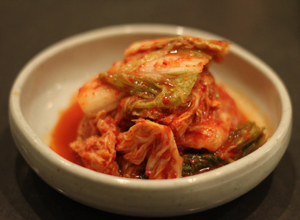
Kimchi is a condiment and a dish that has to be on every table every day — and is. It consists of brined cabbage and turnip eventually mixed with a paste of red peppers and garlic, but there are a myriad of variations. Each family has its secrets, whether it is the addition of eggplant, cucumber, sesame or chive. The delicacy is then kept in jars or coolers in the kitchen, the garden or on the balcony and eaten year-round. There are industrial versions, but for the traditionalists, such a perversion is a sin. Kimchi is a significant emblem of Korea’s gastronomical culture; nationals are proud of it and can’t think of living without it. There’s even a museum devoted to Kimchi and a popular celebration is held annually.
Not only do Koreans think it is a delicious food, but also a panacea. Rich in fibers, minerals and vitamins, it helps digestion and lowers cholesterol. The South Korean government has wondered why Korea would keep such a natural wonder for herself, when it could be exported to the rest of the world? So with the help of 100 scientists and nutritionists (and probably marketers), a World Kimchi Institute has been created with the purpose of globalizing Kimchi to glorify the gastronomical image of Korea and complement the already remarkable export efforts. Kimchi could help to feed the whole world.
The latest news is that Koreans were reassured when they learned that the next cabbage harvest looks promising and observers say that the Kimchi scare is over. The G 20 conference had some success, too: they were able to shoot a rare picture of twenty smiling heads of state. However, for fixing the world disorder, it seems they need some more time and they will talk about that at the next conference.
The Pulmuone Kimchi Museum
The Korean Ministry for Food, Agriculture, Forestry and Fisheries
A Recipe for Baechu Kimchi
You can click on each photo to enlarge
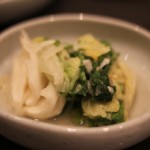
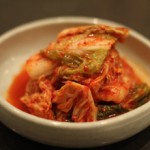
- Baechu Kimchi
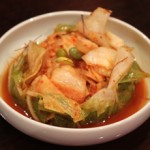
- Kimchi comes in many varieties and differs from region to region in Korea
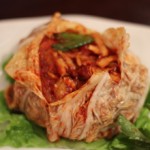
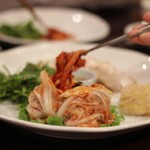
- The artful presentation of kimchi at a Korean restaurant
- Kimchi is an excellent accompaniment to most entrees in Korean cuisine
- Baek Kimchi
1 Comment »
RSS feed for comments on this post. TrackBack URL


[...] of Elements Kitchen who cleverly crossed cultures with their satisfying marinated flank steak kimchi tacos. The most memorable food product of the day: Sushi Poppers! Stefan Richter (Stefan’s [...]
Pingback by Green & Great Chefs | GAYOT's Blog — November 16, 2010 @ 6:23 pm