
Couscous is Big in the
Capital
Paris' Love Affair with
Semolina
 |
|
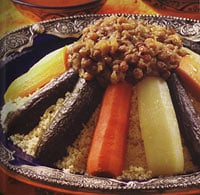
Couscous Bedaoui by Meera
Freeman
|
Couscous has
almost become a national dish in France.
Perennially popular, couscous is even offered
in company cafeterias where it enjoys more
success than paella and pot roast. Writer and
epicurean George Sand, mistress of Frédéric
Chopin, is reputedly responsible for the first
published recipe of “kous-kous” around the time
of the French colonization of Algeria in the
19th century.
Before couscous was considered to be a main
course all on its own, the semolina grain was
traditionally served as a side dish in French
households, prepared with milk, honey,
hard-boiled eggs, raisins, sugar and
butter.
In the 1960s, with the onset of North African
immigration to France, couscous “à la
française” became a fixture in the French diet
with the addition of grilled kebabs, spicy
merguez sausage and roasted lamb. According to
the traditional Algerian recipe, couscous is
prepared with turnips, chicken and fennel,
while couscous with tomatoes, potatoes and lamb
is associated with the Kabyle people from the
mountainous northern region of the
country—Kabyls aren't Arabs; they're an African
Berber tribe.
 |
|
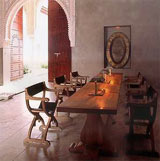
Ksar Char-Bagh
|
Couscous
affords chefs a great deal of freedom and room
for interpretation. Take Alain Passard of
Arpège, who serves Argan oil-scented
semolina as an accompaniment to his legendary
vegetable dishes, or Damien Durand of Ksar Char-Bagh restaurant in
Marrakech, Morocco, who composes his successful
lobster couscous from a saffron-infused
semolina with a fennel bisque.
Semolina adapts nicely to almost all kinds of
sauces. However, in better Parisian couscous
restaurants, the crowning glory is usually a
very high quality marga or broth, as
well ras el hanout, a fragrant blend
of fine spices used to season meat. Couscous
has become such a staple in Parisian kitchens
that even some of the city’s Brazilian
restaurants serve cuscuz de milho,
made with corn and manioc flour. Even if its
resemblance to North African couscous is
remote, "Brazilian couscous" proves that this
grain is growing in popularity the world
over.
Quality
couscous can be enjoyed at the following
favorite Parisian restaurants:
La Boule Rouge
1, rue de la Boule-Rouge
75009 Paris
01 47 70 43 90
Couscous with dried apricots and pumpkin is one
of the traditional Jewish-Tunisian specialties
at this family-style restaurant, where on
Saturdays patrons can indulge in a complete
fish-based dinner.
Mansouria
11, rue Faidherbe
75011 Paris
01 43 71 00 16
Fatema Hal’s celebrated Moroccan restaurant is
renowned for her ras el hanout,
setting her refined, exotic cooking far apart
from the rest.
La Maison de Charly
97, bd Gouvion-Saint-Cyr
75017 Paris
01 45 74 34 62
This is by far the most generous Moroccan
restaurant in Paris where a 29 euro lunch menu
includes aromatic appetizers, fine couscous
served with a delicious broth and a variety of
grilled and roasted meats.
Wally le Saharien
36, rue Rodier
75009 Paris
01 42 85 51 90
Back in the 1970s, Wally Chouaki was the first
to introduce Parisians to couscous au
naturel, served plain without broth or
vegetables.
L'Atlas
10, bd Saint-Germain
75005 Paris
01 46 33 86 98
Benjamin Eljaziri puts together a memorable
tagine made with lamb brain and mild garlic,
accompanied by excellent couscous with raisins,
chick peas and a very aromatic
broth.
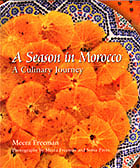
A Season in Morocco: A Culinary
Journey
Learn more about cooking the favorite foods of
Morocco from Meera Freeman,
whose "thirty-year love affair" with the
country has culminated in this effort, part
travelogue, part cookbook. The image of
Couscous Bedaoui featured above was taken from
the book, which features a fine recipe for the
dish, as well as other couscous
dishes.
|












 Over the years, we have been electing restaurants to be on GAYOT's Yearly Restaurant Awards.
 Facebook
 (formerly Twitter)
 Instagram