Joël
Robuchon
Joël Superstar
When a Quiet Man Reaches
Perfection
By
André Gayot
|
|
|
Impression by the "Manet of the
ovens"
|
Joël Robuchon gained stardom status in spite of himself, for
he has always been a discreet character:
unconcerned with publicity; occupied with his
research and dreams in his workshop, a.k.a.
“atelier”; imbibed with spirituality since his
studies at the seminary. Fame came to him
naturally. Why? Because genius does not need
trumpets, even in
Las Vegas. Make no mistake: he is one of
the few who made contemporary gastronomy what
it is today. Were we to compare cooking to
painting, he would be one of the very first
impressionists, a Manet of the ovens. Honestly
enough, Robuchon never forgets to mention the
now defunct Jean Delaveyne, who in the '60s
shook the tyranny of the great Escoffier and
thus paved the way for a totally new culinary
world, dubbed “nouvelle cuisine” in the '70s by
GaultMillau/Gayot.
When
Robuchon opened the cozy but smallish Jamin in
the 16th arrondissement of
Paris in 1982 with very little fanfare, he
immediately earned, without even asking, an
18/20 rating from GaultMillau/Gayot. “Le tout
Paris” rushed to Jamin, savoring his caviar in
cauliflower crème and what became a cult dish,
the “pommes purée.” The quiet man, continuing
to work his way to the summit, received the top
rating of 19.5/20 in 1988, the highest award
ever bestowed on a chef. In a larger and more
elegant setting, in the very chic Le Parc Hotel
on avenue Poincarré in Paris, more enthusiastic
diners could gain access to Robuchon’s
art.
 |
|
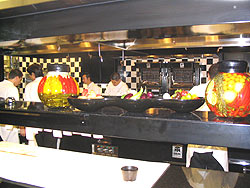
The kitchen: Here's where magic
happens |
Everyone
was stunned when, quietly as usual, Robuchon
announced his retirement in 1996, at the age of
51. Reason was probably that it’s an almost
impossible task to produce masterpieces every
day. The food world agreed with the choice of
GaultMillau/Gayot to name him “Cook of the
Century” in 1990, an honor shared with Freddy
Girardet and Paul Bocuse. As time passed,
Robuchon probably missed the action and the
climax that rises in the kitchen during
service, and he tiptoed his way back with
casual, sub-Robuchon ventures, first in Macau,
then in
Tokyo and finally in
France.
Surprisingly
enough, at
Joël Robuchon, there re-appears a
full-fledged Robuchon. In the food universe
that’s breaking news. Why in the world would he
have elected to operate such a perilous
comeback almost ten years after his eclipse in
the fine dining galaxy, and why would he do it
in a location—at least for his Old World
admirers—as unexpected as Las Vegas?
Without
being too emphatic, Las Vegas is in the process
of becoming if not the, at least one
of the capitals of the world of gastronomy.
Many top chefs shine there and more are coming
soon, such as Parisian star
Guy Savoy. The arrival of Robuchon is a
milestone in this evolution. His presence is
recognition of the status of Las Vegas. Sin
city exists now as a restaurant
town.
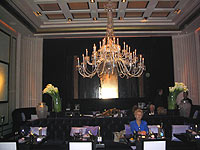 |
Main room, softly illuminated by a
teardrop crystal
chandelier |
Rumor
also has it that Robuchon, who rejected
numerous offers, was charmed by
MGM Grand President Gamal Aziz. He was so
convincing and open-minded, we are told, that
the French chef decided to take the risk of
returning to haute cuisine in grand style.
There’s also the murmur that Robuchon opened
his two restaurants at the MGM on the faith of
a handshake, no contract having been signed.
Not a surprise, when one is aware of his true
nature.
Here we
are entering into Joël Robuchon, welcomed by
the experienced and knowledgeable general
manager Loïc Launay through a gleaming foyer
opening on the main room, softly illuminated by
a tear-drop crystal chandelier hanging from a
high ceiling. On the sides of the foyer, a
private dining room on the left faces the bar
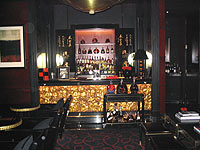
on the right. Architect Pierre-Yves Rochon
found his inspiration in the Art Deco era,
using black, purple and crimson hues to create
a refined and cozy atmosphere centered around a
monumental black fireplace with an actual fire.
Don’t miss the anecdote placed on the
mantelpiece: a statue in the very Art Deco
style represents two lions, a humoristic
allusion to the famous MGM symbol.
Strongly
supported by his landlord, Robuchon and his
team wanted this setting to be nothing less
than perfect. Air conditioning is modulated to
make diners comfortable. Lighting has been
measured to properly illuminate the dishes and
to create enough shade to soften the wrinkles.
The black lacquered tables are positioned just
so, well separated but close enough not to feel
isolated. The seats are comfortable enough for
diners to remain at ease for as long as a
sixteen-course dégustation menu lasts. The
reduction of noise aims to shelter our ears.
Indeed, this is the perfect showcase for
Robuchon’s feast, prepared by executive chef
Claude le Tohic, who worked with Robuchon at
Jamin.
 |
|
Art Deco-inspired bar
|
Depending
on your appetite and your wallet, two
dégustation menus are offered, composed of ten
or sixteen courses, paired with a selection of
wines by the glass, some of modest origins but
flavorful (and affordable) such as the Coteaux
du Languedoc Bronzinelle.
The
first mouthful of his lemon gelée flavored with
vanilla and topped with an anise cream tells us
right away that Robuchon stands as high as can
be in the culinary Gotha, for the refreshing
and complex taste of this amuse-bouche can be
found nowhere else. Robuchon has not changed,
pursuing his eternal quest for the best, trying
new ideas and products in the intimacy of his
kitchen when the fever has subsided. He
researches and experiments with new ideas and
submits them to the jury of his impeccable
palate. When they pass they will flourish on
the next menu.
 |
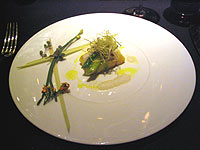 |
Who
could have imagined the extraordinary marriage
of caviar with a green asparagus garmented with
melisse leaves? Chlorophyll dots wrap the fresh
tomato and king crab millefeuille in a verjus
coulis. This incredible constellation of
miniscule green spots necessitates a
workmanship of twenty minutes per plate. After
seducing the eyes, the beautiful art caresses
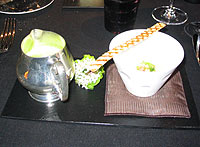
the palate. A light lettuce cream in a silver
pot is meant to be poured over delicate sweet
onion custard. The plate comes with a tiny
bouquet as pretty as it is tasty, composed of
garlic flowers wrapped in a lettuce leaf. This
is the most delicate and exquisite rendition of
a consommé that one could ever think of. When
the seaweed lemon butter scallop melts in the
mouth, it’s like breathing in the ocean. We
stay in the marine environment with a superb
pan-fried sea bass with lemon grass foam with
baby leeks. When you think you have reached
heaven, the sautéed veal chop with natural jus
and vegetable taglierini flavored with pesto
boosts you up to new heights of satisfaction.
Let’s admit it: this is the best veal we ever
tasted.
 |
 |
There
must be a secret for that, one of the many
secrets that Robuchon has uncovered and that
make him so unique. We could explore the confit
of lamb with Mediterranean semoule, the tuna
tartare with a confit of red bell pepper with
bergamot and ham, or the extravagant Brittany
lobster under a disappearing saffron hostie in
a seafood bouillon, but even in the minute
details, we would find that Robuchon’s bill of
fare is flawless.
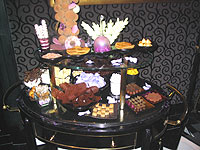
Pastry
chef Kamel Guechida brilliantly brings the
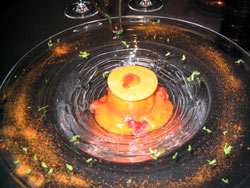
Robuchon festival to an end with his tequila
sorbet and fresh strawberries in lime syrup,
and his melting Araguani chocolate with a hint
of peppermint. The wine list contains 750
labels with many good finds from small American
and French producers at reasonable prices.
Let’s put it simply: there’s only one Robuchon
in the world. An evening there is a unique,
unforgettable experience worth the money it
will cost. Robuchon and his mentor Gamal Aziz
wanted this place to reach perfection. As far
as it is humanly feasible, they’ve made it. We
are glad to bestow on Robuchon his first 19/20
rating in America.
Joël Robuchon
Restaurant
MGM Grand Hotel & Casino
3799 Las Vegas Blvd. S.
Las Vegas, NV 89109
702-891-7925
|











 Over the years, we have been electing restaurants to be on GAYOT's Yearly Restaurant Awards.
 Facebook
 (formerly Twitter)
 Instagram