|

Pizza
Renaissance
New Favorites from Postmodern Pies to
White Versions
The explosion in the number
of pizzerias became a national phenomenon in
France in the 1980s. Pizza was equally popular
across the pond in the U.S., where Wolfgang
Puck invented the designer version, and today
pizza is everywhere, offered by the slice in
the streets and delivered to the homes of the
hungry. Who would have thought that these
humble pies, sold hot in the streets of Naples
in the eighteenth century, would become such a
staple in our modern
diet?
In
Paris, city planning regulations forbid setting
up brick ovens, tolerating only already
existing installations. So forget about the
inimitable smell of pizza cooked in those fiery
hearths. Nevertheless, there is good pizza to
be had, from trendy and postmodern to classic
white with a twist, as the following
restaurants prove:
 |
|
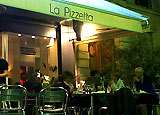
La Pizzetta |
La Pizzetta, on avenue Trudaine in
Paris, is the latest in a slew of "fashionable"
pizzerias. The décor and menu design are
elegant, gray and minimalist. You’ll find a
dozen pizze, cooked in an electric oven. The
margherita is the only "classical" pizza,
showing the colors of the Italian flag. Salami
and fennel, Parmigiano, pear and prosciutto di
Parma, red pepper and basil, eggplant and
sun-dried tomatoes are the new toppings,
providing flavors that slightly veer from
traditional tastes. A good find at La Pizzetta
is the organic whole-meal pizza. Orchestrated
by a talented pizzaïolo, it underlines the
tastes and colors of the quality ingredients,
and is topped with tomatoes, mozzarella and
asparagus, all covered with a thin layer of
Colonnata bacon. La Pizzetta, 22, av. Trudaine,
75009 Paris, +33 (0)1 48 78 14 08.
The
ultimate pizza of pizze is, of course, not on
the menu: the white pizza, the one you can only
dream about. We’re not talking about pizza “al
tartufo,” with tomato, mozzarella, basil and
white truffle oil, with its dreadful synthetic
aroma. No, we are referring to the original
pizza. Before the addition of the tomato
brought back by Christopher Columbus, at the
end of the Middle Ages, pizza was the local
adaptation of an Anatolian recipe for "pide,"
which means bread.
The
white pizza of lore gets a postmodern twist at
Maria Luisa, a Parisian pizza
temple, just nearby the Canal Saint-Martin.
Made in an electric oven, it is topped with
cheese and Italian green lettuce such as
arugula, whose slight bitterness
counterbalances the usually bland taste of the
tomato paste so often used by undiscerning
restaurant owners. Maria Luisa, 2, rue Marie et
Louise, 75010 Paris, +33 (0)1 44 84 04
01.
The
pizza tradition is still very much alive around
the Mediterranean. Chez
Etienne, a place where each patron has
a favorite, in the Panier area of Marseille,
has been faithful to its origins since 1943.
“My father was already preparing pizza,” says
joyful owner Etienne Cassaro. His restaurant is
simply named “Pizzaria” and it offers the best
pizza in Marseille. Pizzaria, Quartier du
Panier, Marseille, no telephone; credit cards
not accepted.
Across
the Atlantic in
New York City, where you can find pizza of
all kinds, colors and toppings (even
grapefruit), Frank DeCarlo, a fiery New Yorker,
operates
Peasant, an extraordinary
pizzeria right in the heart of Little Italy. In
a red brick garage dating from the Prohibition
period he installed large, candlelit tables
previously used in a convent. From the dining
room area, one can observe the kitchen where
the chef uses a wood oven to grill meat and
cook pizza the way it is done in Abruzzo.
Peasant, 194 Elizabeth St., between Spring and
Prince Streets, 212-965-9511.
Casa Cristo, 20, rue Pierre Leroux,
75007 Paris, +33 (0)1 45 67 86 07
Al Dente, 38, rue de Varenne,
75007 Paris, +33 (0)1 45 48 79 64
Grand Bar Restaurant des
Goudes, 28, rue Désiré Pellaprat,
Marseille, +33 (0)4 91 73 43 69
|












 Over the years, we have been electing restaurants to be on GAYOT's Yearly Restaurant Awards.
 Facebook
 (formerly Twitter)
 Instagram