|
 Toujours Bubbles Toujours Bubbles
Toques,
Trends & Top
Restaurants
by
Alain Gayot
Dear Reader,
Welcome to
our Annual Restaurant Issue. In our world,
there is a plethora of restaurant
establishments that are all different, and
all fighting for life with a variety of
motivating forces. A restaurant is strictly
a business for some, and a labor of love
for others. Whether an eatery is trying to
take your dollar or your heart, there are
many degrees of success, and quite a bit of
risk involved. The restaurant galaxy is a
bit like a glass of Champagne; pour in the
sexy beverage and watch the bubbles travel
up the glass, then take it into your body
and feel the action.
Our
rating system often confuses
restaurant-goers, but we’ve used it for
over forty years, so we’re keeping the
tradition alive. The rating on a twenty
point scale is used to grade the food only.
Ambience, service, décor and other parts of
the dining experience are addressed in the
review. So for the most part, our
restaurants are at the top of our
toque tallies because of what you will
find on your plate.
Since
we are now publishing our work on the
Internet, we actually update these ratings
year-round, unlike printed guides. The
speed at which stars are born and vanish in
the eatery stratosphere is astonishing.
Ventures open and close before you’ve even
been able to jump on OpenTable.com to secure
a reservation.
It’s
important for our readers to understand
that beyond the food rating, an
establishment appears on our “Top
40 Restaurants in the U.S.” list
because it offers everything that a
successful dining room must provide: top
ingredients, pronounced creativity in the
execution of the food, solid service and a
look that you’ll want to emulate for your
next remodel. A small independent
restaurant that has remarkable food but a
perfunctory wine list would not make the
grade, nor would a top dining room with all
the trimmings where the chef has fallen
asleep at the wheel. There might not be
anything completely wrong with the place,
except that nothing has changed in ten
years. Top golfers and tennis pros
eventually fall from their apex and
consequently, so do their scores. Even if
they maintain their skills, but fail to
improve, others may come along who surpass
them.
How
many times have you dined at a restaurant
that you tell yourself you’ll never visit
again? Others continue to frequent the
place, and they don’t seem to find a
problem with it. GAYOT.com has
been copied on countless letters to
establishments where diners got sick and
were seeking damages. This illustrates the
risks in evaluating dining. One dish may be
off. Perhaps a bad shrimp got into the
batch or the chef was thinking of something
other than food that evening. Perhaps he
was simply tired and too much salt got in.
Does Tiger Woods win every Grand Slam
tournament? The worst is going in with high
expectations, which is understandable,
especially when you just listed your new
exotic car on eBay to finance the meal.
Our role is to give you a map of the solar
system, to point out the safe planets to
avoid asteroids and to simply watch
shooting stars.
I, along with my father André and my sister
Sophie
Gayot, want to congratulate all the
hardworking men and women whose restaurants
are heralded herein. We welcome those who
made our
Top 10 New Restaurants list as well as
the nine restaurants that have never earned
a spot in our
Top 40 before. With so much talent at
work in the kitchen, choosing our
Rising Chefs was perhaps our most
difficult task. If you get the chance, try
tasting the work of other notables,
including Iacopo Falai, Marco Bustamante,
and Ryan Racicot, whose older brother Dave
made our list this year.
We
also celebrate the return of
Urasawa,
Seeger’s, and
Le Rêve to our
Top 40 after their brief absence last
year. And while we’re on the topic of
resurrection, we’re thrilled to see
Le Cirque, like an acrobat, make a
successful landing on New York Mayor
Michael Bloomberg’s turf at One Beacon
Court, where it can continue to entertain
diners. We’d like to bid a sad farewell to
L’Orangerie, which will close its doors
Dec. 31, 2006, after 28 years of fine
dining, as well as other notable
restaurants like
Bastide.
We
also want to thank our growing staff of
trusted and dedicated professional food
writers around the world who have helped
make this issue, and our website, a
success.
Best
wishes of health and prosperity to all of
you.
 |
|
In
last year's Restaurant
Issue, we remarked on how
top chefs were transforming
Las Vegas from a gambling
mecca to the
Restaurant Capital of the
World. With the
triumphant openings of
Restaurant Guy Savoy and
Michael Mina’s
Stripsteak, his first
steakhouse, the culinary
explosion along the Strip
continues. But other
goings-on in the restaurant
world have caught our
attention over the last
twelve months:
In the past, a peek into the
kitchen of most great
restaurants would reveal
either a French chef or one
trained in Europe. But now,
thanks to fine culinary
institutions like the
California Culinary Academy
and The Culinary Institute of
America, the United States is
generating a lot of homespun
talent who were born and
learned to cook stateside.
Besides national pride,
another benefit of home-grown
chefs is the pressure they
put on their region’s farmers
to produce fresh local
ingredients.
The small plates concept has
been around for a while, but
more and more tapas
restaurants, lounges and
wine bars are focusing on
the fun factor instead of
food. Their casual,
comfortable atmosphere has
made them more of a place to
hang out for good times
rather than gourmet
cuisine.
While literally billions of
these simple sandwiches have
already been gobbled up by
Americans, more and more
places are concentrating on
the humble but heralded
hamburger. In most cities
you can buy and eat one
without getting out of your
car for the change found
under the driver’s seat, but
they are also being prepared,
deconstructed and cooked to
order by top chefs.
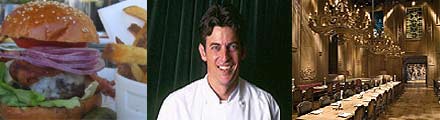
Hamburgers made from Kobe
beef are showing up on top
menus from coast to coast,
and the hottest item at
DB Bistro Modern in
Manhattan is the $32 sirloin
burger filled with braised
short ribs, foie gras and
black truffle. (Don’t worry,
it comes with fries!)
Although
steakhouses are still
quite popular, at the trendy
Hollywood Roosevelt
Hotel, many people ignore
Dakota for the more
casual atmosphere of
25 degrees, which
specializes in burgers, both
beef and turkey. Even
über-chef
Hubert Keller of
Fleur de Lys couldn’t
resist opening his own
Burger Bar on the Vegas
Strip.
Americans like things BIG,
and restaurants are no
exception. Despite astronomic
real estate prices in
Manhattan,
Buddakan, a two-story
Chinese mansion filled with a
labyrinth of corridors
connecting various chambers
including a sunken ballroom,
measures a whopping 16,000
square feet. That’s nosed out
by
Jack’s La Jolla, which
houses three different San
Diego restaurants under one
roof covering 17,000 square
feet. The City of Big
Shoulders is also the City of
Big Restaurants with the
Latin-themed
Carnivale taking up a
staggering 35,000 square
feet, bigger than the last
two restaurants
combined.
But some restaurateurs still
see the joy in thinking
small. True artisans like
Daniel Patterson at
Coi in San Francisco and
Guenter
Seeger at his eponymous
restaurant in Atlanta are
following in the footsteps of
Ken Frank (pictured above) of
La Toque in Rutherford,
Calif., who knows that the
best way to please diners is
to give their food as much
attention as he can. Frank
gave up his trendy business
on the Sunset Strip to open
an intimate place that is all
about the food, and not so
much on the scene. Coi has
just 27 seats in its main
dining room, allowing
Patterson to focus more on
each course of his customer’s
meal, as opposed to becoming
a food factory.
Which of these last two
contrasting trends will play
a bigger role in the dining
scene of the future? Come
back and see what we have to
say
next year!
|
|
|












 Over the years, we have been electing restaurants to be on GAYOT's Yearly Restaurant Awards.
 Facebook
 (formerly Twitter)
 Instagram