Corton
Following in the Fine Dining Footseps of Montrachet
by
John Mariani
 |
The 2006 closing of one of New York's seminal restaurants of the late 1980s, Montrachet, quite possibly foretold the shift in dining out that occurred as the economy slowed down. Montrachet was opened on a shoestring--and a loan from his mother--by Drew Nieporent, whose gamble in locating down in TriBeCa, when there were very few restaurants of any kind there, paid off overnight with rave reviews.
Chefs came and went as Nieporent expanded his holdings through his Myriad Restaurant Group to include Nobu and several of its branches, while a certain movie star glamour attached itself to several of the enterprises, since people like Robert De Niro and Robin Williams were partners in some of them, so the restaurants were a draw for that, as well as culinary reasons. But Montrachet's time in the sun had faded over the years, especially since TriBeCa, which it helped jumpstart as a restaurant destination, become overgrown with new and more casual entries. The fact that the economy started to collapse didn't help, and Nieporent (who still has the admirable Tribeca Grill, Nobu New York, Next Door Nobu, Mai House and Centrico in the neighborhood) let Montrachet's premises lie fallow from 2006 until now. Its replacement is the very serenely cool Corton.
Where Montrachet was never highly decorated, Corton is barely so, in a minimalist style of pale champagne color walls, widely separated tables, soft lighting and white tablecloths set with Riedel, Laguiole and Christofle. I'd like to see some color or artwork on those walls.
The chef is something of a surprise: British-bred Paul Liebrandt, whose training at Pierre Gagnaire seemed to urge him on to carve out a dubious reputation with extremely experimental, idiosyncratic cuisine and service at other restaurants like Atlas and Gilt; at another restaurant, he held dinners in complete darkness. So I was puzzled as to why Nieporent had taken him on at a restaurant that, like Montrachet, seemed to evoke the refined traditions of Burgundy. Having now dined at Corton, I see that Nieporent must have known that under the veneer of eccentricity lay Liebrandt's considerable talents for a purer cuisine.
Within days of opening Corton was visited by some of New York's finest chefs, all curious to see if Nieporent and Liebrandt were divining the future of New York gastronomy.
I'm not sure anything quite so prescient is going on at Corton; I do know that the cooking is of a very high order with some engagingly novel ideas but not a whit of pretense about the evening's proceedings. Indeed, Nieporent has always been an exemplary host--part bon vivant, part partygiver, and full professional. So he's likely to greet you and chat with you throughout the evening, and is likely to know most of the people in the room. Just as you sit down, out come hot gougères pastries filled with Mornay sauce--a very lusciously good start indeed.
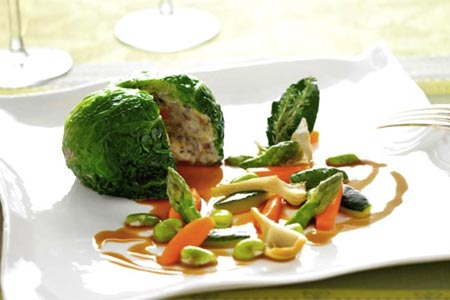
The remarkable thing to me about dining out several times a week, here and abroad, is how chefs keep coming up with marvelous new ideas no others have had before, and to do so without getting showy about it (as many of Liebrandt's dishes once were). At Corton he will make a lovely, classic velouté of Jerusalem artichokes with crabmeat, but just by adding a little Parmesan and smoked pasta, makes it new and exciting. Simple and simply perfect baby vegetables with fruits and herbs taste like the first salad of Eden, while scallops take on a light brininess from the subtle use of sea urchin cream in addition to the crispness of radish and almonds, while caramelized veal sweetbreads come with an oozing egg yolk "confit," carrot, and argan oil--a superb dish. I'm not sure adding a layer of beet borscht gelée and blood orange to foie gras pushes the envelope any further than others have.
Liebrandt, working out of a very small kitchen, does brilliant work with seafood, where the subtleties of his craft show the best in dishes like cobia with potato-eggplant terrine, black olive, and something called "vadouvian spice," an Indian mixture. Turbot, usually a very bland fish when served this side of the Atlantic, took on some grace notes from having a spiced almond crust, black garlic and a citrus-coconut broth.
Meats work almost as well at Corton, including a rolled squab with chestnut cream, smoked bacon and foamy pain d'épices milk (I'd hoped foams had passed into culinary limbo by now), though a filet of beef with beets, oxtail and fondant potato was good if ho-hum.
For dessert, Robert Truitt's gianduja "palette" gives you a heavenly trio of chocolate, hazelnut, and tangy yuzu in profusion.
Corton's winelist of course offers many wines of Corton, at varying price levels, and I commend Nieporent for carrying about three dozen good country wines under $50. In this economy, that is where the sweet spot is.
The local reviews for Corton thus far have been raves, and I can see that the restaurant will evolve into one of the city's very finest. My compliments to Drew Nieporent for his persistence in believing in fine dining and to Liebrandt for finding where his true talents lie.
Corton
239 W. Broadway (Walker St.)
New York, NY 10013
212-219-2777
|
|
John
Mariani is well known for
his frank and poignant writing in Esquire, Wine Spectator, Diversion and the Harper
Collection. He is author of The
Encyclopedia of American Food &
Drink, The Dictionary of Italian Food
and Drink and co-author, with
his wife, of the Italian-American
Cookbook. |
|
|